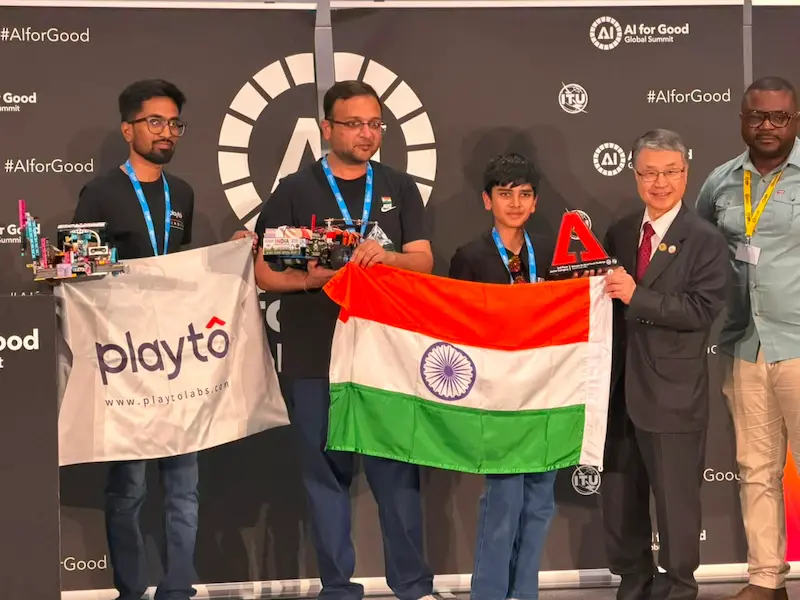
 Global · 2026
Heyansh Aggarwal
3rd place globally · Junior category
Grand Finale, Geneva, Switzerland
Represented India after winning the India national finals.

What if the robot your child builds could do more than move around the room? What if it could tackle a challenge inspired by a real problem? That’s the idea behind the Robotics for Good Youth Challenge, an educational competition from the International Telecommunication Union (ITU), through its AI for Good initiative.
For students, it’s a chance to turn an idea into a working robot and see what it can do. If your family or school is curious about taking part from India, here’s how the challenge works, what to expect, and where to begin.

The journey starts with a national competition and can lead all the way to the global Grand Finale in Geneva, Switzerland. Here are the key details to help you get your bearings.
| Organizer | International Telecommunication Union (ITU), through AI for Good |
|---|---|
| India partner | I-Hub Foundation for Cobotics (IHFC), the Technology Innovation Hub of IIT Delhi, with support from the Department of Telecommunications (DoT) |
| What students do | Design, build, program and test robots for a mission inspired by a real-world challenge |
| Categories | Junior and Senior; see the 2026–2027 rulebook eligibility details below. |
| Robotics kit | Platform-agnostic; no mandatory robotics kit. Hardware and programming tools must comply with the edition’s rules. |
| India event | 10 October 2026, Yashobhoomi, Dwarka, New Delhi, as part of India Mobile Congress (IMC). |
| Global Opportunity | The India 2026 winners in both categories qualify for the Grand Finale in Geneva, Switzerland, in 2027. |
Looking for more robotics competitions? Explore our guide to robotics competitions for kids.
For Playto Labs student Heyansh Aggarwal, winning the Junior category at the India national finals in 2025 led to representing India in Geneva, where he placed third globally in the Junior category in 2026. Aarav Jai Singh and Naithik Nannan also earned national honours. Their achievements offer a glimpse of where a child’s interest in robotics can lead.
Global · 20263rd place globally · Junior category
Grand Finale, Geneva, Switzerland
Represented India after winning the India national finals.
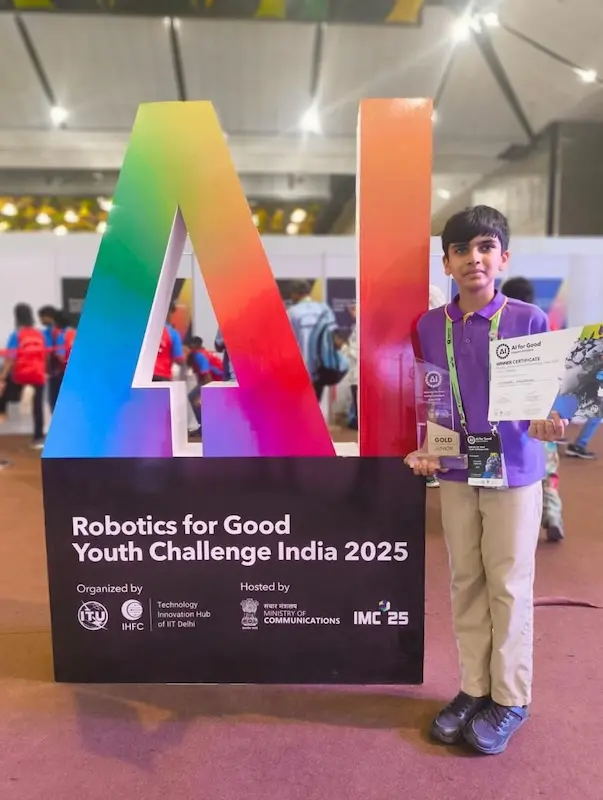 National · 2025
Junior category winner
Robotics for Good Youth Challenge India
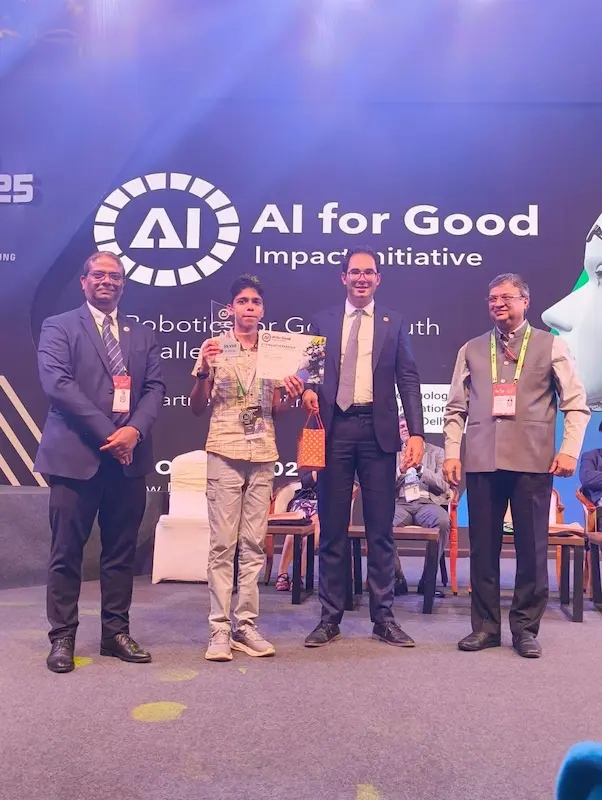 National · 2025
Senior category first runner-up
Robotics for Good Youth Challenge India
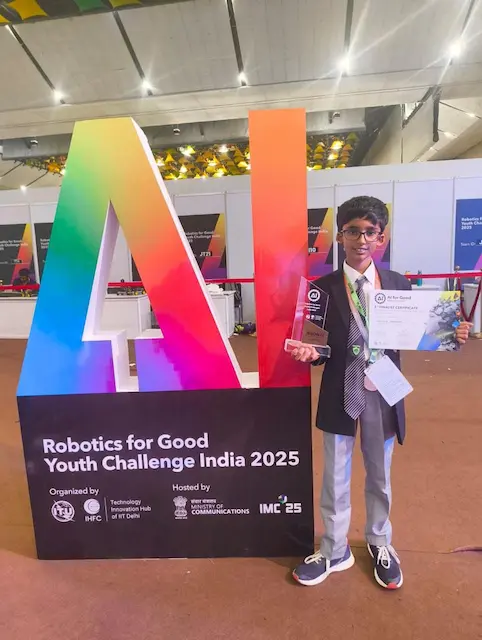 National · 2025
Junior category second runner-up
Robotics for Good Youth Challenge India
Sources: Official Ministry of Communications announcement: India finals · IHFC India 2025 winners list · ITU Geneva 2026 results.
At its heart, this challenge asks a question: how can we use robotics to help people? Students explore that question by designing, building, and programming a robot for missions inspired by problems that affect communities.
The interesting part is figuring out how an idea works in practice. A mechanism that looks promising on paper might need a different grip. A robot that moves beautifully in a straight line might struggle with a turn. Each attempt gives students something to investigate, change, and try again.
There’s room to make their own design choices, too. ITU describes the competition as “platform-agnostic”: students can choose hardware and programming tools they are comfortable with, within the competition rules. You can explore the idea behind the challenge in the official competition overview.
Think of the India competition as a journey from introducing your robot online to demonstrating it on a national stage, with a chance to go further.
ITU publishes the problem statement and rulebook on the AI for Good competition website. The India event is coordinated by the I-Hub Foundation for Cobotics (IHFC), the Technology Innovation Hub of IIT Delhi, with support from the Department of Telecommunications (DoT).
Here’s how that journey generally unfolds:
The details for each edition, including deadlines, submission formats, selection results, and the confirmed venue, are published in IHFC’s announcements. One detail that can be confusing: an India competition and its corresponding global finale may fall in different calendar years.
For the India 2026 event, IHFC links to the 2026–2027 rulebook (PDF). It lists Junior participants born in 2013–2017 and Senior participants born in 2009–2012, inclusive.
There is a discrepancy: ITU’s general overview displays different birth-year ranges. The ranges above are quoted from the edition-specific PDF linked by IHFC; confirm your child’s eligibility with IHFC before making plans.
The India event page allows individual or team participation. The linked rulebook permits teams of up to eight members, with at most three in the competition area. Other members and mentors must stay outside that area and cannot coach competitors during a round.
IHFC requests age proof, participant and category details, and contact details for a team member and coach or mentor. Check the India announcement for entry documents and any additional mentor requirements. Registration for the 2026 India event is closed.
Choose hardware and programming tools that you are comfortable with, and components that suit your robot’s design. The rulebook still sets the boundaries for things like robot size, operation, and safety, so it’s a useful starting point before buying anything.
A good question to ask together is: “Can we build, program, and fix this ourselves?” A simple robot your child understands is a great starting point. As they gain confidence, they can add more to it.
Depending on the design, you may need a controller, motors and drivers, a battery and charger, sensors, a chassis, and parts for any moving mechanisms. A few spares can also save a practice session when a small part gives way.
For the 2026 India edition, competition entry is free. Equipment, optional training, and travel can involve separate costs. You’ll find participation details in IHFC’s official announcement.
Registration for India 2026 is closed. IHFC lists registration from 10 to 25 August 2026, practice on 9 October, and the national final on 10 October at Yashobhoomi, Dwarka, Delhi. The winners qualify for Geneva in 2027. See the official timeline and updates; future entrants should wait for the next edition’s announcement.
For a future edition, use the registration form linked from the organizers’ announcement and save your acknowledgment after submitting. An old edition’s form does not establish entry to a new competition.
Alongside the robot itself, allow for practice-field materials, replacement parts, shipping, and any instruction or travel you choose. If your child qualifies internationally, ask the organizers what travel or accommodation support is available before making plans. That way, you can celebrate the opportunity with a clearer picture of the costs.
The India 2026 event uses the 2026–2027 public health emergency response theme. Robots simulate collecting samples, closing a quarantine zone, delivering medical supplies, and sorting patients by urgency. Use the IHFC-linked 2026–2027 rulebook (PDF) for the field diagrams and scoring tables.
Key rules in that edition include:
These highlights are a starting point; the complete rulebook and organizer updates determine competition requirements.
As you explore the missions together, focus on a few questions:
Understanding the scoring helps students decide where to put their effort. A mission they can complete consistently gives them something solid to build on.
A competition robot rarely comes together in one perfect build. It grows through small experiments: a turn that gets smoother, a sensor that becomes more dependable, a mechanism that finally holds its grip. Here’s how we at Playto Labs suggest approaching that process, alongside the official rules.
A whole mission can feel daunting. Break it into actions your child can picture: move to a spot, sense an object, pick it up, or place it somewhere. Sketching one mechanism at a time makes the challenge easier to explore before everything comes together.
Can the robot stop at a marked point? Start there before adding a collection mechanism. Once it works, try it ten times and note how often it succeeds. Getting a task to work repeatedly gives your child a useful measure of progress and a reason to feel proud of the improvement.
If the robot misses a turn, the code may not be the only reason. A wheel could be slipping, or the chassis could be out of alignment. If a sensor behaves differently across runs, compare its readings under different lighting or at different distances before adjusting its threshold.
Changing one thing at a time helps your child discover what made the difference. A short note such as “adjusted wheel alignment; four successful turns out of five” can be surprisingly useful at the next session.
When the individual tasks are working, try the full sequence with a timer. Include the setup routine, too. A slightly different starting position or a lower battery charge can reveal something you hadn’t noticed in practice. Finding that out at home gives you time to work on it.
Those early sketches, photographs, code versions, and test notes tell the story of how the robot improved. They also help your child explain their choices in their own words: what they tried, what didn’t work, and why they changed it. Leaving time for the required report or video makes it easier to share that work clearly.
As submission day or the finals approach, a little organization goes a long way. Keep the registration acknowledgment and deadlines handy, give the robot a final size and safety check, and save a tested backup of the code. Label the spares and charging equipment so they’re easy to find.
Then give your child a chance to do a timed run and talk you through the robot. Explaining a build to someone else can help them notice what they understand well and what still needs a little practice.
These are our preparation suggestions; the organizers’ rules set the competition requirements. If your child is just getting started, our robotics for beginners guide is a friendly place to begin.
For national placements, see the IHFC India 2025 winners list. For international placements, see the ITU Grand Finale 2026 results, including Team Heyansh’s third place in the Junior category. For India 2026 preliminary results and subsequent updates, visit IHFC’s 2026 announcement. The 2026 national final is scheduled for 10 October; the 2025 winners list is historical.
It’s an educational robotics competition from ITU’s AI for Good initiative. Students turn their ideas into working robots for missions inspired by real-world challenges.
The 2026–2027 rulebook linked by IHFC lists Junior birth years 2013–2017 and Senior birth years 2009–2012, inclusive. ITU’s general overview shows different ranges, so confirm eligibility with IHFC. See the edition-specific rulebook (PDF) and India announcement.
Students can choose hardware and programming tools they are comfortable with, as long as the robot and its components meet the competition rules.
Yes. Small projects involving movement, sensors, and debugging are a good place to start. The mission brief and the time available will help you decide whether to enter this edition or build experience for a future one.
India 2026 registration is closed. For a future edition, start with the official IHFC announcement, use its registration link, submit the requested documents, and save your acknowledgment. Wait for the next edition’s announcement before applying.
IHFC lists practice on 9 October and the India national final on 10 October 2026 at Yashobhoomi, Dwarka, Delhi. Registration is closed. Check IHFC’s timeline and the ITU event page for updates.
Download the 2026–2027 rulebook linked by IHFC (PDF). Read it alongside the India-specific instructions and updates. For another edition, use that edition’s rulebook.
No. India’s October 2026 national event qualifies winners for the Geneva Grand Finale in 2027. The historical India 2025 winners competed in the Geneva 2026 finale.
No. You register through the official organizers, who manage competition entry. Playto Labs offers optional robotics learning for children who would like support building their skills.
Whether your child is aiming for a competition or simply curious about how robots work, there’s plenty to enjoy along the way: building a mechanism, writing the code that brings it to life, and figuring out how to make it work better.
If you’d like support with that journey, explore robotics classes at Playto Labs to help your child build confidence in designing, coding, and testing their own robots.
This guide is from the Playto Labs team. For official competition requirements and entry decisions, the competition organizers are your source.